
Where Will the Stock Market Go in 2026?
 That’s the big question this year. After a period of elevated volatility and sharp reactions to U.S. policies, uncertainty feels like a constant in markets. Traders and investors are trying to make sense of price action amid tariff cycles, deregulation waves and shifting geopolitical risk.
[Note: This blog is shared only for educational purposes — not investment or trading advice. Markets are inherently unpredictable and can move in any direction.]
Looking Back at My 2025 Market Outlook
In last year’s post “Where Will the Stock Market Go in 2025?”, I leaned on historical patterns — like Jay Kaeppel’s seasonal studies and traditional trend analysis — to set expectations for a volatile but opportunity-rich year. That approach aligned with reality: my portfolio finished 2025 with a 21.9% gain, outpacing the S&P 500’s 17.9%.
Still, that result was lower than my 2024 performance, which reflects how unpredictable volatility has been this cycle.
If nothing else, 2025 reminded us of this hard truth: markets can trend higher even amid sharp political and economic shifts — until they don’t.
How Did First Month of 2026 Go?
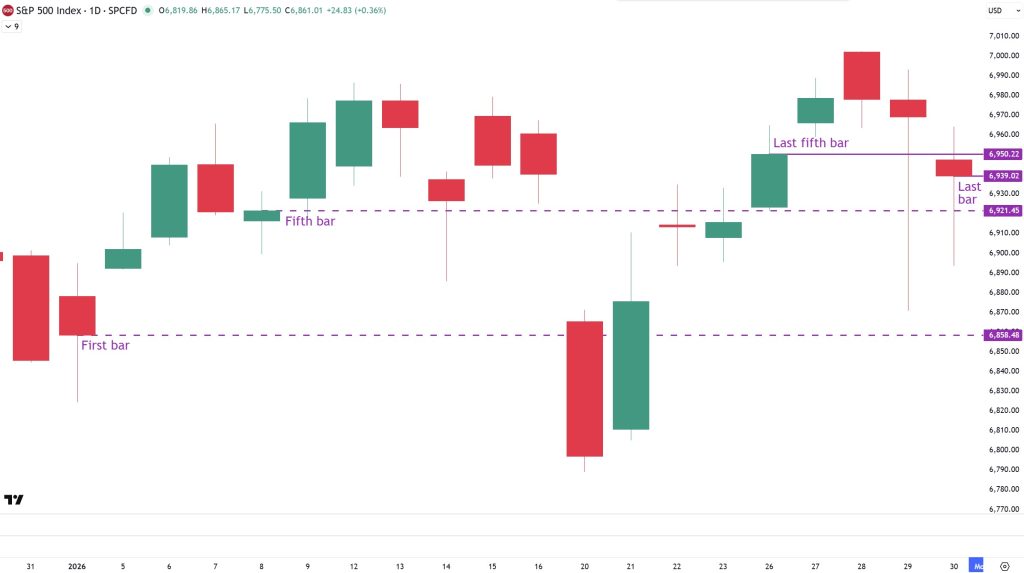
Let’s have a look at the chart from TradingView. Below is how January 2026 for S&P 500 (SPX) perform. It ended higher which is a good sign. I’ll explain in the next section.
Where Will Stock Market Go In 2026?
Wall Street forecasts positive earnings growth and continued AI-driven momentum, even as sector leadership rotates and volatility persists in 2026.
For the fifth year running, I’m turning to historical tendencies to frame the odds for 2026. This approach doesn’t predict outcomes, but it helps me think in terms of probabilities rather than reacting emotionally to headlines. To aid in this, I revisit Seasonal Stock Market Trends by Jay Kaeppel — a study of more than 70 years of historical market behaviour. The book outlines 13 different seasonal patterns that, while not predictive on their own, offer useful clues about how the market has tended to behave under certain conditions.
Now, let me be clear — no single indicator or historical pattern guarantees results. Markets evolve, and history doesn’t repeat perfectly. But it often rhymes. These trends give me a structured starting point, helping me frame probabilities rather than rely on emotions or headlines. I encourage you to treat them the same way — as a reference point, not a crystal ball — and always combine them with your own research, analysis, and risk management.
For 2026, I’ve narrowed my focus to three key trends that I believe offer meaningful insight into how the year could unfold.
Trend 1 – The January Barometer
The January Barometer assesses early January performance as a proxy for the year’s direction. Historically, it has had a ~71% success rate in predicting whether the market finishes higher or lower
For 2026, here are the key data points for the S&P 500 (SPX):
- Jan 2, 2026: Closed at 6,858 (First trading day)
- Jan 8, 2026: Closed at 6,921 (Fifth trading day)
- Jan 26, 2026: Closed at 6,950 (Last fifth trading day of January)
- Jan 30, 2026: Closed at 6,939 (Last trading day of January)
This barometer examines three signals:
✅ First 5 trading days: Market was up → Bullish signal
❌ Last 5 trading days of January: Market was up → Bearish signal
✅ Full month of January: Market was up → Bullish signal
👉 Based on historical data, this suggests a 91% probability that the market will end the year higher. This is the first encouraging sign.
But remember — probabilities aren’t guarantees.
Trend 2 – Yearly Seasonal Trends
Looking at U.S. market history from 1900 onwards, years ending in “6” have tended to finish positive:
📈 Average annual gain: 7.04%
📊 Winning percentage: 100% (Every “6” year in the study had positive gains)
👉 This is our second encouraging sign for an uptrend market in 2026.
Trend 3 – U.S. Election Cycle
2026 is the second year after a U.S. presidential election, which historically has mixed results:
📊 63.2% of these years ended positive
⚠️ Key Risk Factor: Donald Trump’s policy shifts, including tariffs and economic strategies, could introduce significant market volatility.
👉 This is a wildcard trend. Unlike the first two trends, this one suggests a more uncertain market, requiring careful monitoring and quick reactions. This cycle’s uncertainty is reflected in sharp sentiment swings — with tech experiencing sell-offs in early 2026 even as energy stocks outperform.
Observation 4 – SPX Performance in January 2026
Now, let’s look at technical analysis for additional confirmation. As of Jan 31, 2026, the market closed:
✅ Above SMA50, SMA150, and SMA200 (indicating strength)
✅ SMA50 > SMA150, > SMA200 (classic uptrend pattern)
✅ All three moving averages trending upwards (bullish confirmation)
👉 This reinforces the bullish outlook—yet another encouraging sign!
Sector & Thematic Outlook for 2026
The trend looks constructive — but leadership will rotate. An uptrend doesn’t mean everything rises together.
So the real question isn’t just “Will the market go up?”
It’s “Where is capital flowing?”
🔹 Tech & AI – Still dominant, but narrowing leadership means selectivity is key.
🔹 Energy & Industrials – Policy shifts and geopolitics may continue to support them.
🔹 Financials – Sensitive to rate stability and credit conditions.
🔹 Defensives – Likely to outperform during volatility spikes.
👉A quick institutional takeaway: major market research sees AI adoption, geopolitical influences, and tech-led sector divergence as key themes this year.
Strong markets reward discipline; they punish late chasing.
Final Thoughts: What Does This Mean for 2026?
🔹 2 out of 3 historical trends are bullish, suggesting the market has a constructive bias heading into 2026.
🔹 The election cycle remains a wildcard, which means volatility should be expected.
🔹 Technical indicators confirm a strong uptrend, reinforcing the positive setup.
Taken together, the probabilities favour bullish movement — but likely with rotation and corrections along the way.
For me, this means:
🔹 Staying with the primary trend
🔹 Managing risk proactively
🔹 Adjusting exposure when conditions change
The goal isn’t perfect prediction. It’s disciplined positioning.
2026 may offer opportunity — but only for those prepared to navigate the swings.
To Your Trading Success,
Keith Choy
💡 What’s your take on the market for 2026? Let’s discuss in the comments!
Related posts
Where Will Stock Market Goes In 2025?
How US President Election Impact The Stock Market (View 1)
Fibonacci Levels Stock Trading Strategies – Clear Trend
Stock Strategy For Bull Market
5 Powerful Candlestick Patterns In Stock Trading
